Game Director | VR/AR Specialist | Robot Simulation & AI
Hi, I'm Kent
I've spent more than 25 years building interactive 3D worlds, most recently as a game director in VR. Now I'm bringing that experience to robot simulation and AI. My robotics projects are at the top of the list below.
What I bring
User-centered design as a game designer I learned how people deal with complex systems, and how to make systems intuitive and easy to use.
3D worlds, physics and VR years of building, tuning and debugging simulated worlds.
Prototyping and coding I build things hands-on, in Python, C# and Unreal Blueprints, to find out quickly what works and what doesn't, and adjust course.
Working with AI I use AI to write code and to analyze data. My understanding of code quality and software architecture lets me direct it effectively and critically review its output.
Leadership setting a vision, getting a team behind it, and seeing a project through to the finish line.
I taught myself game development, from 3D modeling and level design to coding and game design. Eventually I led a team of 50+ people on a world-famous IP. Along the way I shipped games on almost every platform, including Metro Awakening, which won Steam VR Game of the Year 2024.
I'm now teaching myself robot simulation and AI the same way: by building. Besides the projects on this page, I've built countless prototypes and demos that never shipped on their own but helped make other projects a success.
A simulated Franka robot arm that sorts and stacks red, green and blue cubes on matching pads. It can be driven by a scripted controller or by a trained policy, using either privileged simulator data (exact positions straight from the simulator) or computer vision.
Solo research project (2026) | Isaac Sim, Isaac Lab, Python, OpenCV, BC-RNN
My goal for this project was to learn how computer vision and imitation learning work, and to expand my knowledge of Isaac Lab / Isaac Sim robotics simulation. I started from NVIDIA's cube stacking tutorial and grew it into my own task: cubes keep spawning on the table, the arm places each one on its colored pad, and full stacks of 3 disappear. Built with AI coding assistants (ChatGPT/Codex and Claude).
What I built
World state: one module that holds everything the robot needs to know (cubes, pads, stacks). It is fed by privileged simulator data or by the vision system, switched with one setting.
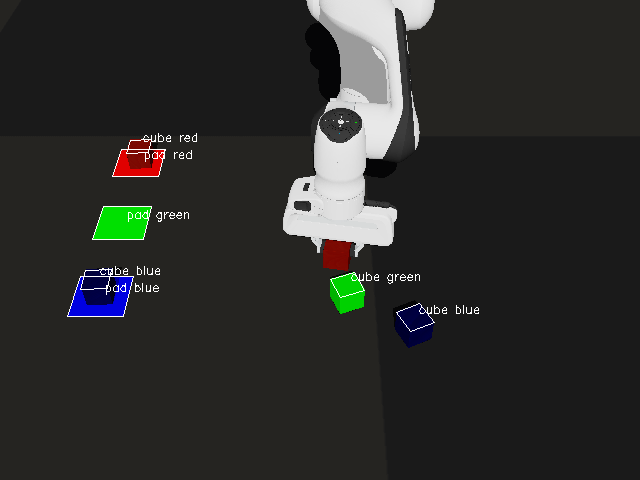
OpenCV detection of cubes and padsVision system: OpenCV finds the cubes and pads in a color + depth camera image and turns them into 3D positions.
Expert controller: a scripted controller that makes its decisions from the world state. It runs smoothly on vision data, and it records the training demos for imitation learning (using simulator data).
Error injection: modules that make the expert deliberately miss a grasp, grab a cube off-center or misplace it, and then show how to recover.
BC-RNN policy: a neural network with short-term memory that learns the task by copying the expert's demos.
The journey
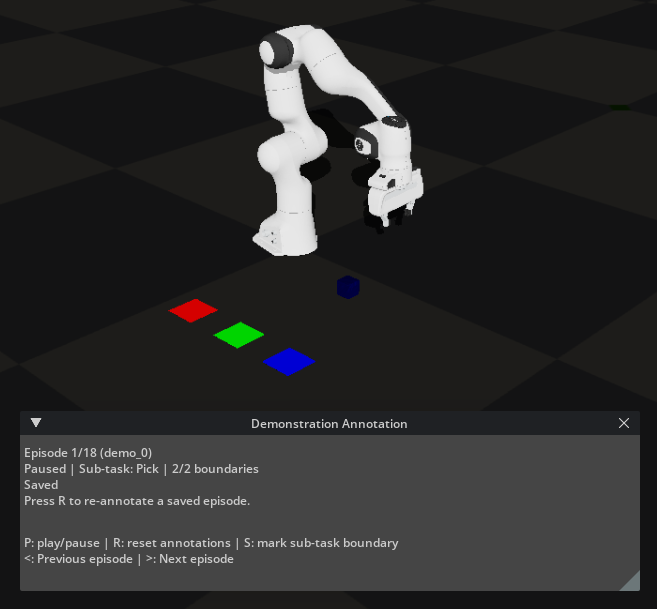
My annotation tool for marking sub-tasks in recorded demosNov 16-17setup and hand-recorded demos: built my own scene on top of NVIDIA's tutorial (cube spawner, colored pads, wrist cameras, better keyboard controls, recording tools). Recorded demos by hand and used NVIDIA Mimic to make variations. The trained policy was too shaky to reliably grab a cube.
Nov 18expert controller: wrote a scripted expert that uses simulator data to pick, place and stack cubes, and records demos automatically. Even with about 300 demos, longer memory and fewer inputs, the policy grabbed at "phantom" cubes.
Nov 19-20finding the real cause: extra inputs such as a task-stage predictor did not help. Then I measured that about 95% of the expert's moves could be predicted from the hand's last movement alone. Its timed speed-up and slow-down was invisible to the policy, so the policy learned "keep moving" instead of "go to the cube". I changed the expert to simply move toward its goal, gave targets as distances from the hand, and normalized the inputs.
Nov 21first breakthrough: after making all coordinates consistent, the policy picked up, delivered and stacked several cubes in a row on its own. It still struggled to recover from bad grasps and badly placed cubes.
Nov 22-23error injection: the expert now makes deliberate mistakes (missed grasp, off-center grasp, bad placement) and shows the recovery. At first the policy also learned to copy the mistakes, so I changed it to only record the recovery. The policy worked again, but grasps were often 5 to 10 cm off and placements 4 to 5 cm off.
Nov 24chasing accuracy: tried extra loss weight near the target, smoother expert paths, twice as many demos, removing the arm joint inputs, adding hand velocity and 5x longer training. None of it made a clear difference.
Nov 25debugging by overfitting: trained on just 3 demos to test the pipeline. The policy always closed the gripper at step 16, no matter where the hand was. The cause was a fixed wait in the expert after grasping. Without it, the policy lifted the cube in 10 of 10 training scenes (before: 3 or 4 of 7).
Nov 25vision: built an OpenCV detector that turns color + depth camera images into 3D cube and pad positions. Made the world state independent of its data source. The expert now picks and places efficiently using vision only.
Lessons learned
How BC-RNN imitation learning works:
Training data: recorded expert demos of the task.
Input: observations, such as hand position and object positions.
Output: the next action, a small hand move and rotation plus an open/close gripper command.
Training: the network is adjusted over and over until its actions match the expert's actions as closely as possible.
Running: about 20 times a second the policy looks at the observations, picks an action, and the robot executes it.
Clean training data is key: garbage in = garbage out.
Observations the policy learns from must contain everything it needs, and preferably nothing more. There should be no hidden mechanisms the policy cannot "see" through its observations, like the fixed timers in my expert controller.
Be data-driven. As a game designer I built strong intuitions by watching players, and made most design decisions from my own observations. I caught myself doing the same with robot controllers and policies, and learned to use AI to record and analyze large amounts of data instead.
Change one variable at a time. Not new to me (I learned it studying physics), but re-affirmed: when iterating or hunting a cause, change only one thing and keep everything else constant so the results can be better interpreted.
A simulated Franka robot arm that picks up a cube, moves it along a planned path and places it at a target. I built the control systems myself instead of using ready-made solutions: motion planning, trajectory execution and a sensor-driven gripper.
Solo research project (2026) | Isaac Sim, ROS 2, Python, IKPy, USD / URDF
My goal for this project was to get hands-on experience with robot control, kinematics, motion planning and ROS 2. I built a working pick-and-place controller system from the ground up in about a week using an AI coding assistant (ChatGPT/Codex).
What I built
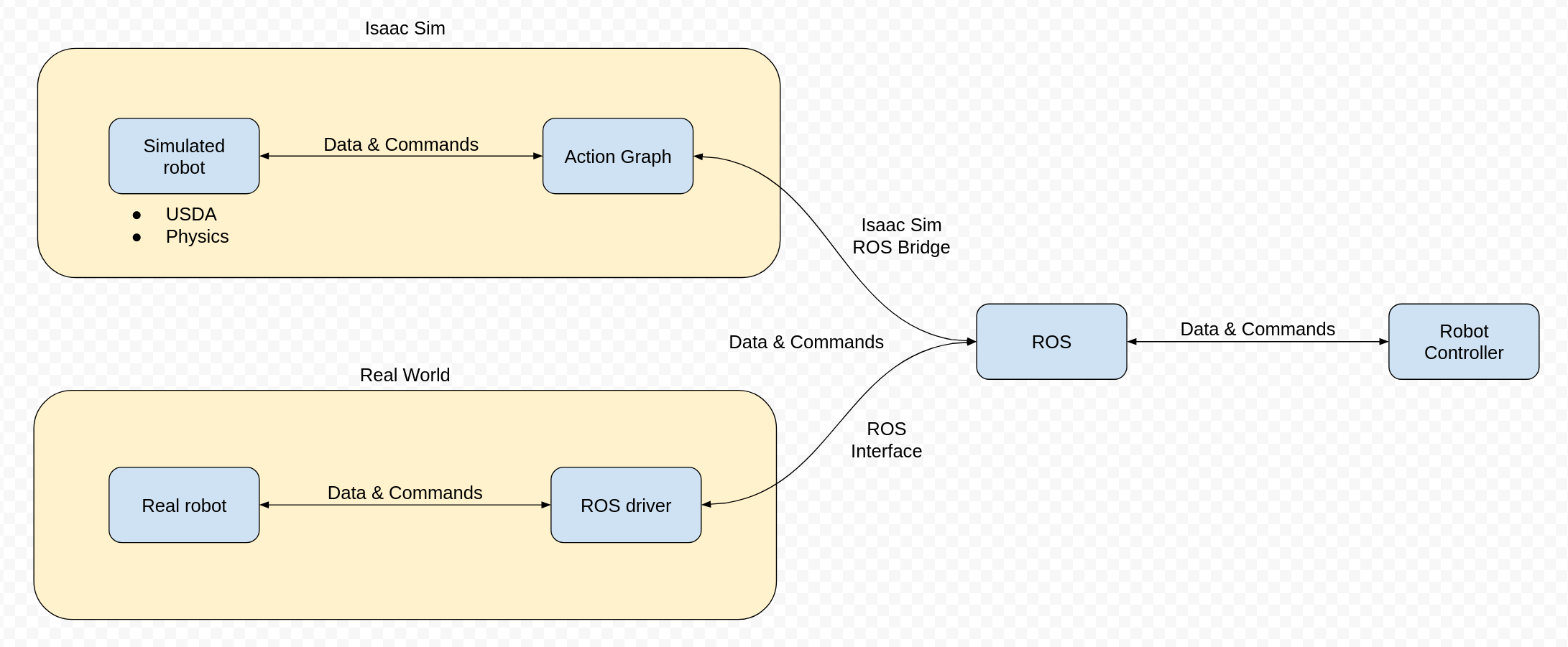
How the controller talks to the simulated (or a real) robot through ROS 2ROS 2 control layer: sends joint commands to Isaac Sim and reads joint and sensor feedback in real time.
Kinematics and motion planning: inverse kinematics and a path planner for straight-line moves, joint moves and multi-waypoint paths with rounded corners.
Trajectory execution: smooth speed-up and slow-down, with speed and acceleration limits taken from the Franka specs.
Gripper controller: a state machine (closing, clamping, holding) that moves each finger on its own and uses contact and force sensors to get and keep a firm grip.
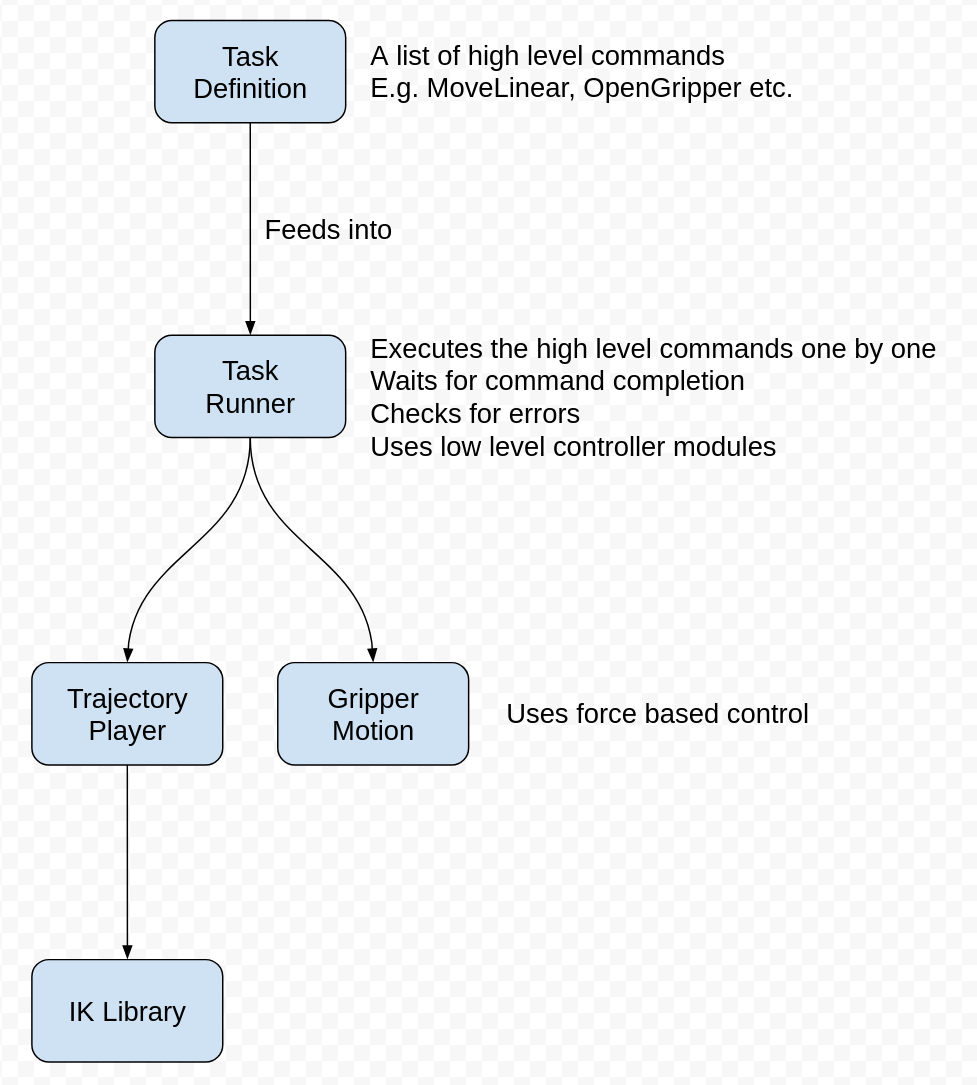
Task system architectureTask system: chains arm and gripper operations into tasks, with the gripper able to open or close while the arm moves.
Safety monitoring: checks movement accuracy, joint limits and unexpected deviations, and aborts if something goes wrong.
The journey
Nov 5-6setup and kinematics: set up the Franka scene and ROS 2 connection. Checked that a separate URDF model matched the simulated robot, then built IK, straight-line trajectories and my own trajectory player (the standard ROS 2 one was not available in my Isaac Sim version).
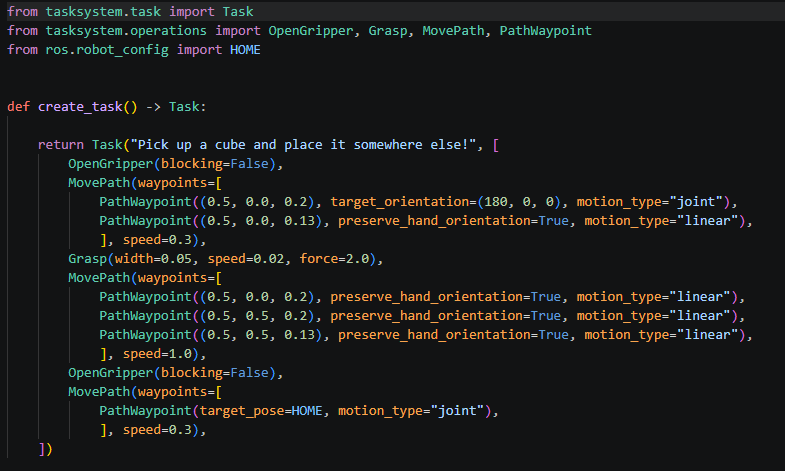
A pick-and-place task defined in PythonNov 7task system: built a task runner for arm and gripper operations. Ran into the IK solver picking solutions with extreme joint speeds (over 360 degrees per second).
Nov 8-10gripper and debugging: hooked up finger pressure sensors and tried force-based gripping, which took days and hit several Action Graph bugs. I found the joint speeds reported by the simulator were unreliable by comparing them with speeds I calculated myself. A 6 mm position error turned out to be caused by gravity pulling on the arm; I disabled gravity on the arm as a work-around. The proper fix would be to implement gravity compensation in the controller.
Nov 11grasp and paths: rebuilt the grasp as a 3-state machine using the simulator's native position control. Added "as fast as allowed" speed settings and multi-waypoint paths with rounded corners.
Nov 12full pick-and-place: the task works end to end. Let the gripper open and close while the arm moves, and moved the safety checks into their own module.
Lessons learned
How ROS 2 works: separate programs (nodes) talk by sending messages over named channels (topics). My controller used this to send joint commands and read joint states and sensor data.
How to grasp with sensor data: close each finger on its own, stop a finger when it touches the cube, then raise the grip force until both fingers reach their target force.
Check assumptions. Don't blindly trust what the simulator reports. Measuring it myself showed the reported joint speeds were wrong. From games I'm used to unpredictable physics forces and torques, but I didn't expect it in Isaac Sim. My below-min-spec PC may be part of the cause.
Isaac Sim Action Graph. Avoid Action Graphs for complex logic. Mine became cluttered and ran into editor bugs.
A six-legged robot I designed myself and taught to walk in Isaac Lab with reinforcement learning (the robot learns by trial and error, earning rewards for good behavior). My long-term idea: small modular robots that grab onto each other and form structures, like ants forming a bridge.
Solo research project (2026, unfinished) | Onshape, URDF, Isaac Sim, Isaac Lab, Python
Long-term idea: modular robots that link up into structures
This was my first robotics project. I realized robot simulation overlaps a lot with my game development experience, so I started teaching myself, with ChatGPT and YouTube as my tutors, Codex as coding assistant, and NVIDIA's tutorials as guidance. The concept is a small hexapod robot that can grab onto others like it and form a dynamic 3 dimensional lattice. My plan was to move towards that high flying end-goal step by step and see how far I could get.
What I built
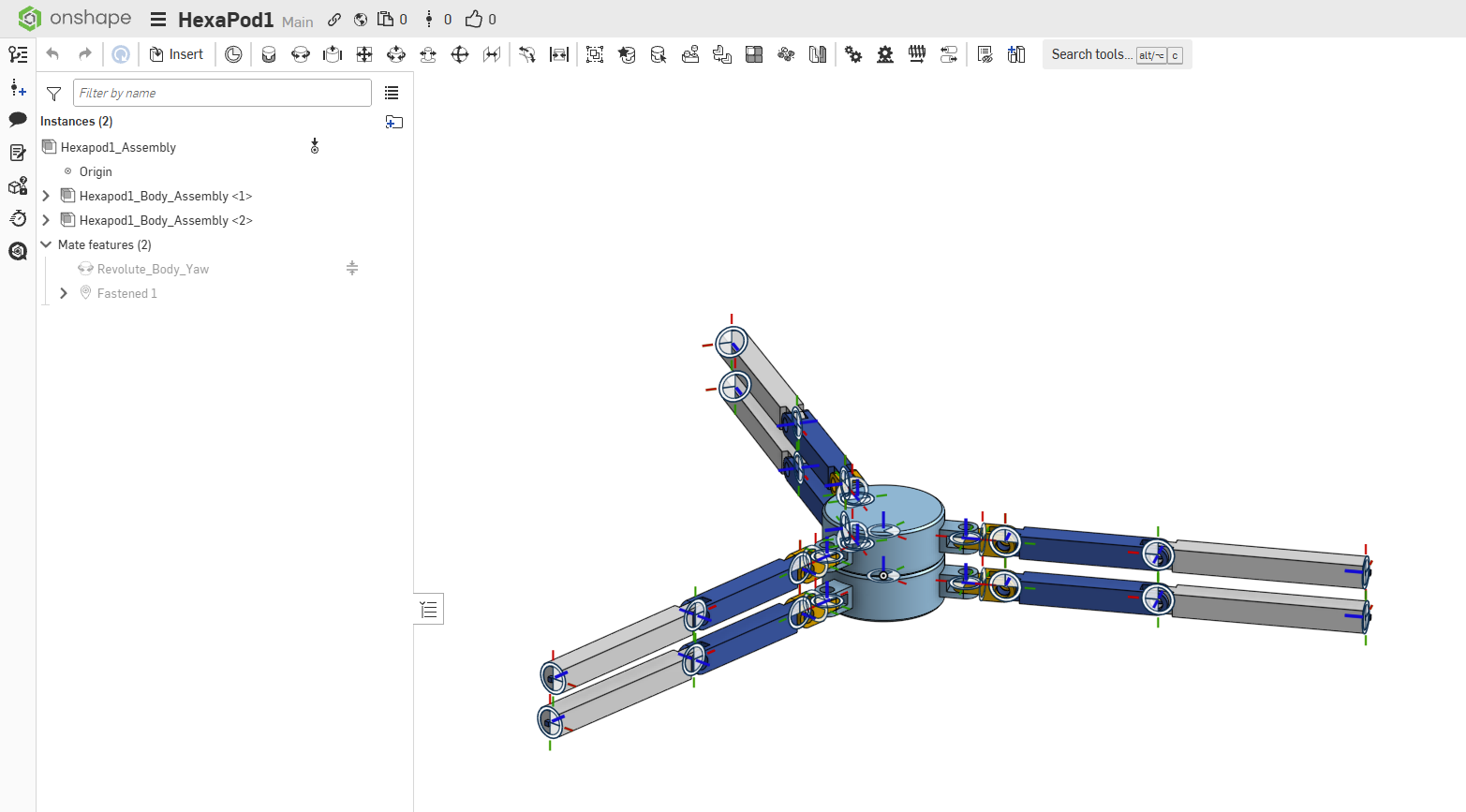
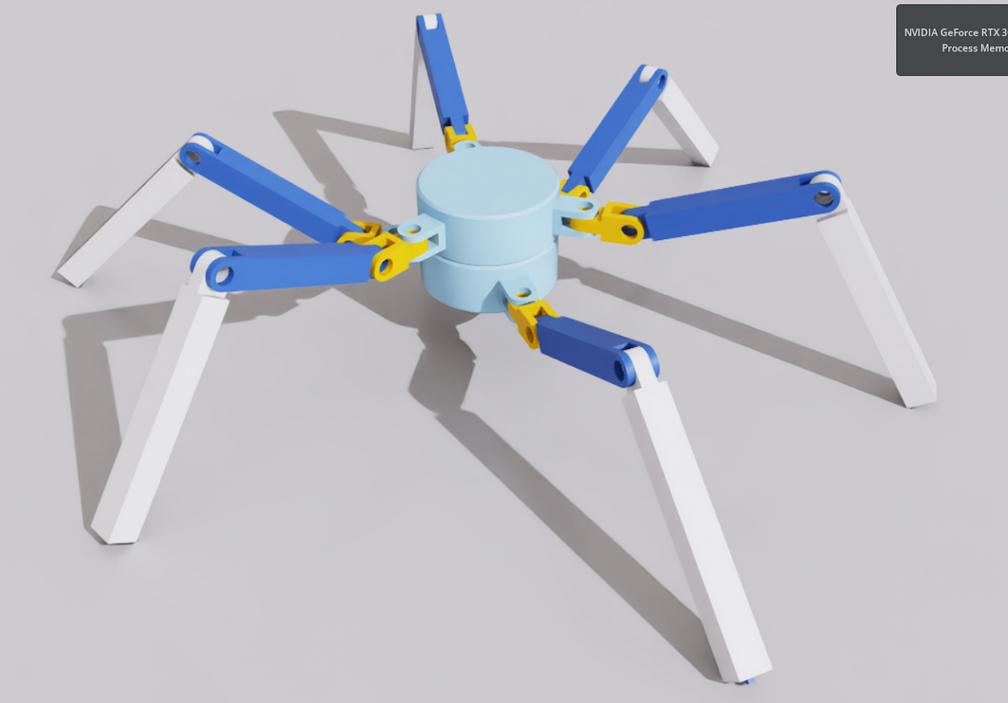
The hexapod assembly in OnshapeRobot design: a hexapod with two stacked bodies that can rotate, each with 3 legs. Modeled in Onshape, exported to URDF and set up in Isaac Sim (collision, joint limits, motor strength).
Joint mapping: 19 standard joint names used in all scripts, mapped to the model's names at startup, so a re-exported model just works.
Scripted tripod gait: a gait player that uses inverse kinematics to walk with two alternating groups of 3 legs.
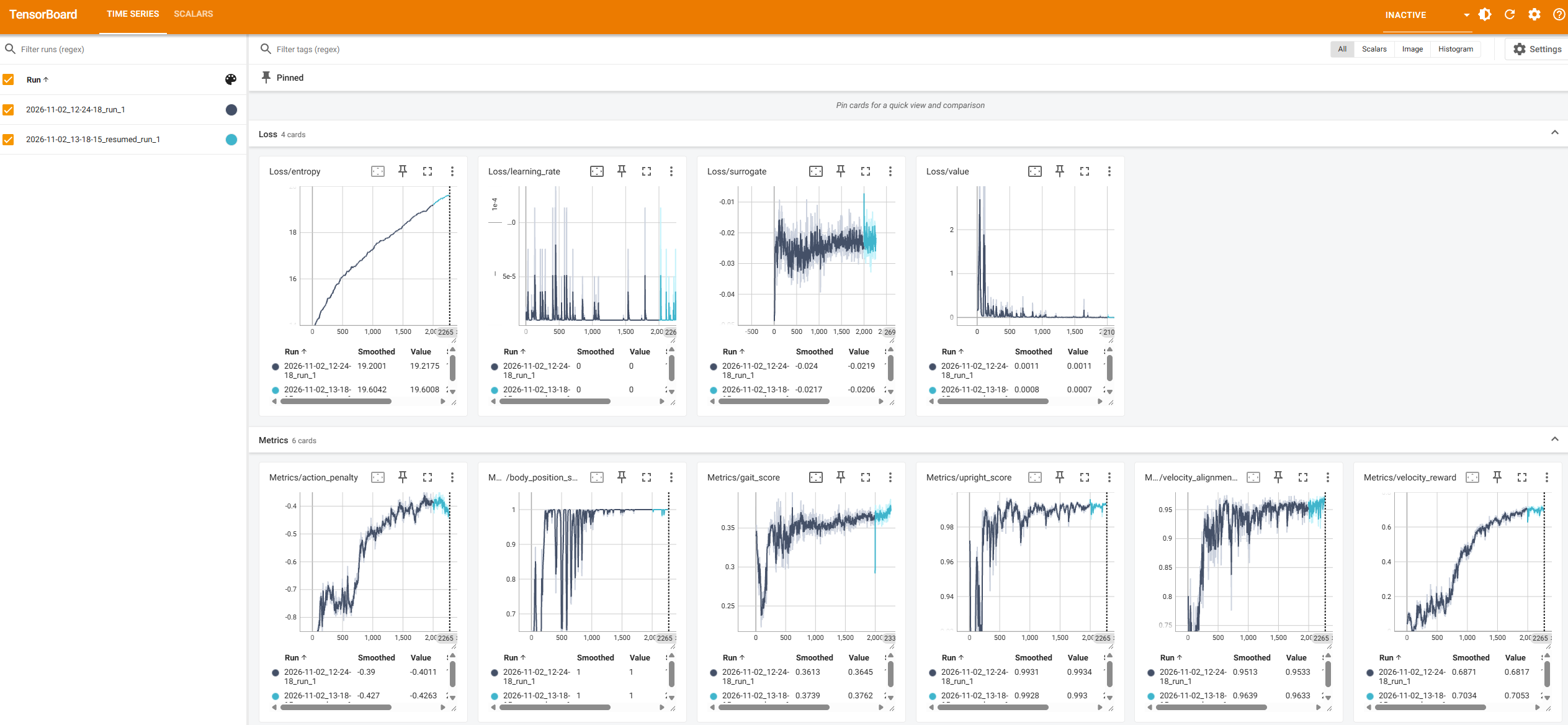
Reinforcement learning setup: rewards for body height, staying upright, speed, direction, body alignment and tripod gait, tracked in TensorBoard.
Workflow tools: one-click VSCode buttons for training and playback, automatic run naming and resuming training from a checkpoint.
The journey
The hexapod set up in Isaac SimOct 15-16design: designed the robot in Onshape, exported it, set it up in Isaac Sim and found a stable standing pose.
Oct 19first training: after 500 rounds with 32 robots, it shuffled forward on 6 legs with tiny jittery steps. I was thrilled. But the AI-written code was a mess, and some of its reward logic didn't match real physics.
Oct 21-23better tooling: set up GitHub and Codex, and wrote an AGENTS.md with coding rules, which improved the AI's code a lot.
Oct 27scripted gait: I wrote the design and pseudo code myself and reviewed it with Codex first. The code it then generated worked on the first try, and watching the robot walk gave me better ideas for rewards that would teach it a tripod gait.
Training metrics in TensorBoardLate Octrewards rework: cleaned up the rewards and added TensorBoard. After 5000 rounds it walked efficiently, but on 4 legs with 2 waving in the air.
Oct 31 - Nov 2fine-tuning: some rewards were switching between on and off instantly, which is difficult to learn, so I changed these into smooth curves. Created rewards for tripod-leg coordination and enabled self-collision. Result: a fairly recognizable tripod gait and no more legs clipping through each other, however the middle 2 legs were mostly just tagging along.
Nov 3where it stands: I iterated heavily on the rewards that should teach the robot a tripod gait, but could not get it to work properly. I decided to put the project on hold and move on to more feasible and commercially applicable projects (like a pick-and-place controller for a robot arm). I plan to return to this project at a later date.
Lessons learned
The core principles of reinforcement learning, and how to set it up in Isaac Lab.
Reward hacking. Reinforcement learning finds the easiest way to score, often not how you intended it. There's an interesting parallel with game design: players often play your game differently from how you intended it. For the tripod gait I found that walking on 4 legs is simply more efficient.
Reward shaping. Rewards work better as smooth curves than as on/off values, so the learner can tell when it is getting closer.
AI coding workflow. Writing the design and pseudo code myself first, and setting clear coding rules in markdown files, gets much better quality code out of AI. For example architecture based on modular design with clear responsibilities and ownership, centralized reusable configurations, clear descriptive naming, guidelines for file, class and function sizes etc.
Games
Unannounced VR Game “U”
A high profile single-player story-driven action adventure VR game based on world famous IP “U”.
My role: Game Director
We
successfully delivered the Vertical Slice which was very well-received
by the main stakeholders Meta and the IP-holder, as well as external
play-testers who rated the fun 7.9/10 and their interest to keep playing
9.4/10. We were gearing up for full production when the project was
unfortunately shut down due to the changing VR gaming market conditions
in Q4 2025.
My contribution:
Defined and evangelized the game’s vision to the stakeholders and the team.
Responsible for budget allocation and prioritization aligning with the vision.
Worked with production and the leads to lay out the roadmap for the full production.
Set up and refined processes and workflows.
Led a team of discipline leads to turn vision into actionable work.
Games
Unannounced VR Game “P”
A high profile single player story-driven action adventure VR game based on world famous IP “P”.
My role: Game Director
We successfully completed the initial concepting
phase together with the IP holder, after which we proceeded into early
pre-production. We delivered a first draft of the full game script which
was approved by the IP holder. We delivered an early gameplay demo (see
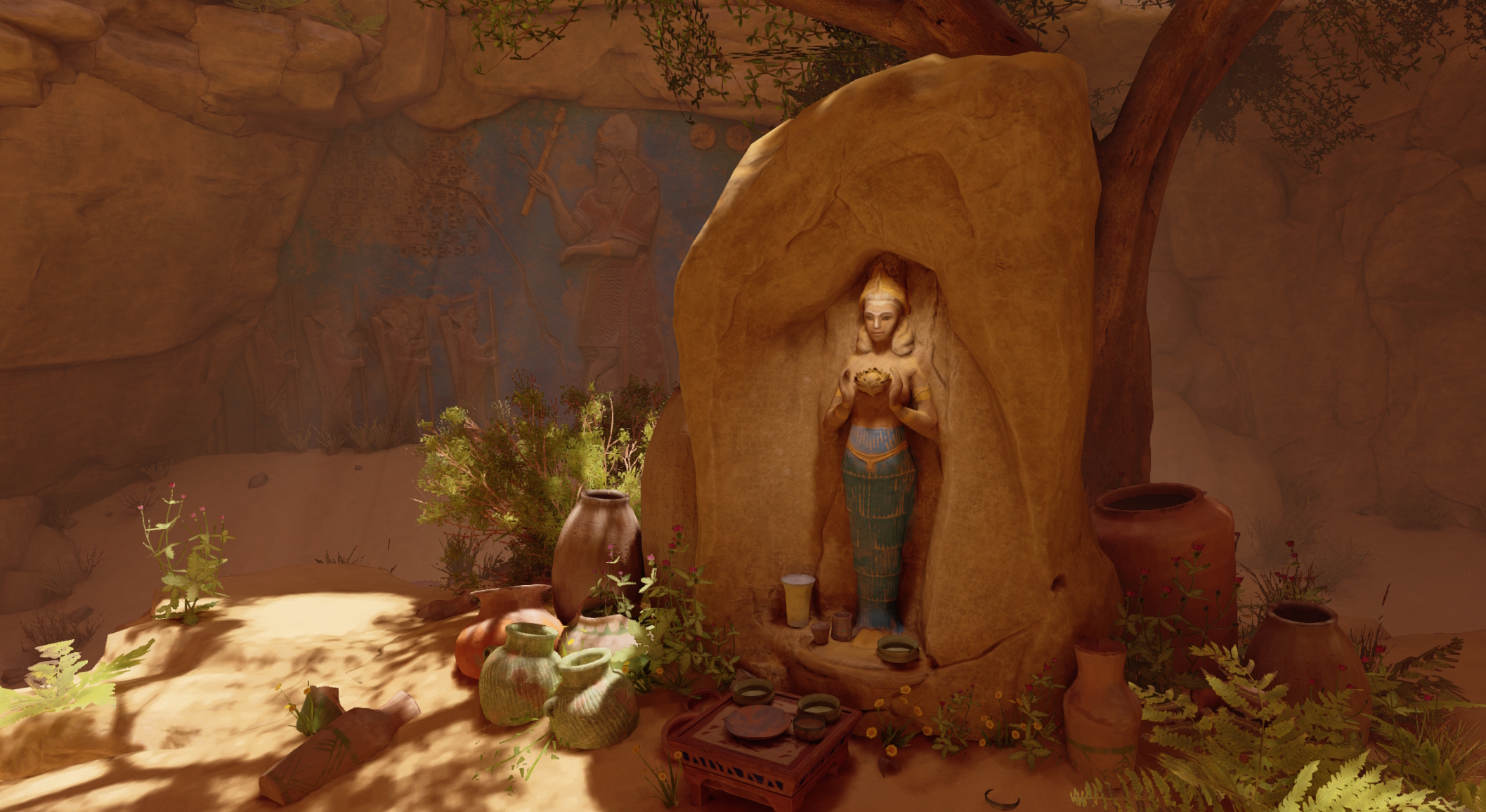
screenshot) that demonstrated some of the core mechanics like climbing,
combat, stealth and basic world interactions. The project was cancelled
due to a shift in company strategy.
My contribution:
Responsible for project vision in close collaboration with IP holder and stakeholders.
Worked with an external writer and the IP holder to flesh out the game’s main narrative.
Led concepting/prototyping team and delivered a well-received playable demo.
Worked with production and the leads to lay out the roadmap for the full production of the game.
Games
Metro Awakening VR
Released on November 7, 2024 for the Meta Quest 2 and on Steam VR.
My role: Lead Game Designer
Metro Awakening is a first person shooter based
on the Metro IP with an original story written by the author of the
Metro books: Dmitry Glukhovsky. The game won the Steam VR Game of the
Year award among other awards.
My contribution:
I worked as the lead feature designer for the majority of this project, at its peak the team consisted of 10 game designers.
I was responsible for all the game’s
gameplay features, including locomotion, weapons, inventory, enemy
design, world interactions etc.
In the finaling phase of the project I helped out with level design.
Games
Coaster Combat
Released in 2017 on the Oculus Gear VR and Oculus GO.
My role: Lead Game Designer
Coaster Combat is a fast paced, mostly comfortable VR roller coaster / shooting gallery game.
My contribution:
Lead design and hands-on design.
Core mechanics prototyping and design.
Level design on all of the tracks.
UI/UX design.
Games
National Geographic Explore VR
Released on May 21, 2019 on Meta Quest.
My role: Game Designer
This is an educational travel experience that
lets the player explore Machu Picchu (created with photogrammetry) and
Antarctica. For this project we worked closely with National Geographic
and their experts.
My contribution:
Worked closely with experts from National
Geographic to ensure everything was accurate, authentic and in alignment
with the brand.
Designed and prototyped core interactions and UI/UX.
Level design and gameplay scenario scripting.
Games
Time Stall
Released on August 15, 2019 on Oculus Quest.
My role: Game Designer
Time Stall is a single player VR physics puzzle
game that lets players slow down time to save a space ship from its
revolting robotic crew.
My contribution:
Created the initial design and prototypes for the game’s main hub: a shuttle full of fun VR toys.
Games
Pet Lab
Released in 2018 on the Oculus GO.
My role: Game Designer
This is a quirky VR game that lets players craft and sell all sorts of crazy critters.
My contribution:
Early concepting and vision development.
Prototyping and design of the game’s core mechanics and interactions.
Finaling, polishing, bug fixing and shipping.
Games
Landfall
Released in 2017 on Oculus Rift.
My role: Game Designer / Lead Game Designer
Landfall is a top-down tactical twin stick shooter game in VR. The game supports single player, 2 player coop, 1v1 and 2v2.
My contribution:
Created the 2v2 multiplayer demo that got the project signed with Oculus.
Led the design team of 7 designers, working on all areas of game design.
Worked on the (very thin) narrative design.
Games
Term1nal
A third person stealth game in VR.
My role: Game Designer
Released in 2017 on the Oculus Gear VR.
My contribution:
I worked on early core mechanics prototypes on flat screen, a different team later adapted the core mechanics for VR.
Games
Halo Spartan Strike
Released in 2015 on Windows 8, iOS and Steam.
My role: Game Designer
A twin stick shooter in the Halo universe, initially designed for Windows 8 mobile.
My contribution:
Overall design of the game as well as the core game mechanics.
Designed and scripted the enemy AI using an in-house scripting tool.
Worked on the narrative- and the level design.
Games
Halo Spartan Assault
Released in 2013 on Windows 8 & Xbox 360 & Xbox One & Steam & iOS.
My role: Game Designer
A twin stick shooter in the Halo universe, initially designed for Windows 8 mobile.
My contribution:
Created the demo that got the project signed with 343i and Microsoft.
Core mechanics design, working closely with 343i to translate the Halo FPS experience into a twin stick shooter.
Enemy AI and combat design.
Level design and gameplay scenario scripting.
Designed the coop game mode for the XBox 360 and XBox One version.
Games
Gatling Gears
Released in 2011 on Xbox360 & PS3 & Steam.
My role: Game Designer
Gatling Gears is a classic twin-stick shooter set in an original steam punk world.
My contribution:
Movement, weapon and camera design, creating playable prototypes in Unity3d.
Level design, including the backstory.
Supported the enemy AI design and game balancing.
Design and balancing of the game’s coop survival mode.
Games
Greed Corp
Released in 2010 on Xbox360 & PS3 & PC & Mac OS & iOS & Android & Linux.
My role: Game Designer / Lead Game Designer
Greed Corp is a unique turn-based strategy game that brings out the worst in people as they strip-mine the world into oblivion.
My contribution:
Initial concept development.
Core gameplay design and prototyping.
UI/UX design.
Games
Earlier Work
Various Titles (2000 - 2007)
My Horse and Me (2007): Wii & PC. Overall design, core mechanics & controls and level design.